Physical prototyping alone creates hidden risks, schedule delays, and unexpected tooling costs late in the engineering cycle. Advanced engineering analysis, including FEA services and CFD testing, allows development teams to identify structural weaknesses, thermal inefficiencies, and fluid flow issues before machining a single part. At Sigma Design Company, high-level simulation is integrated directly into early-stage product development to reduce time-to-market and ensure predictable outcomes.
For CTOs and VPs of Engineering managing complex projects across medical, defense, or industrial sectors, catching a design flaw in simulation is far less costly than catching it in production.
Predicting Failure Before Prototyping
Relying solely on physical prototypes introduces expensive risks late in the design timeline. By the time a physical prototype fails, tooling costs are sunk, and release schedules are compromised.
Finite Element Analysis (FEA) mitigates this risk by applying simulated mechanical, thermal, and dynamic loads to a 3D model in software. This gives engineering teams precise visibility into stress concentrations, deformation points, and required geometry updates.
Our FEA capabilities give engineering teams early visibility into structural behavior:
Linear stress analysis. Evaluates structural response under predictable, proportional loading conditions.
Non-linear plastic deformation analysis. Predicts material behavior when components yield or deform permanently under extreme loads.
Fatigue analysis. Assesses long-term durability under cyclic loading for critical moving assemblies.
Catching these issues in simulation means design iterations happen in software, not on the shop floor.
Optimizing Fluid Flow
For products that manage liquids, gases, or heat, performance depends heavily on what happens inside the system. That’s rarely visible without the right tools.
Simulating internal fluid behavior prevents costly redesigns after initial fabrication. Computational Fluid Dynamics (CFD) models how fluids and gases move through complex systems, identifying pressure drops and thermal transfer profiles early. This allows engineering teams to evaluate dozens of design iterations without building physical test articles.
For example, Sigma engineers utilized SolidWorks Simulation CFD to optimize a client’s heat exchanger design. By evaluating internal geometry options in software, the team established optimal flow distribution and precise thermal control prior to physical fabrication.
CFD simulation provides critical insights across several key design scenarios:
Flow distribution management. Ensures flow patterns directly align with system performance and safety parameters.
Thermal management verification. Validates thermal performance when required by functional or regulatory standards.
Pressure loss reduction. Identifies restriction points to minimize head loss across fluid assemblies.
Stress Analysis for Complex Mechanisms
Assemblies with moving parts, multi-material interfaces, or unconventional geometries present challenges that standard calculations can’t fully capture.
Integrated stress analysis helps resolve multi-physics challenges in critical electromechanical assemblies. By modeling complex geometries and applying real-world boundary conditions, our team evaluates both static and dynamic behavior under severe operational stresses. This rigorous analysis provides the documented design records required for high-reliability medical, defense, and industrial applications.
Our stress analysis and advanced engineering capabilities include:
Electromechanical systems analysis. Evaluates coupled mechanical and thermal stresses in powered assemblies.
Deflection and load visualization. Generates full 3D visual mapping of stress concentrations, deflections, and thermal dissipation.
Root-cause failure analysis. Pinpoints structural failure modes in existing mechanisms and delivers modified, validated redesigns.
When a client brings us a mechanism that has already experienced unexpected failures, stress analysis helps identify likely failure mechanisms and guide corrective designs.
De-Risk Your Next Project with Sigma Design Company
For engineering leaders balancing aggressive schedules with strict quality requirements, advanced simulation renders faster development cycles both responsible and achievable. Integrating FEA services, CFD analysis, and stress analysis early ensures that design issues are solved in software, not during assembly or field operation.
With Sigma Design Company, we offer:
- Documented Assumptions
- Stress/Deflection or Flow/Temperature Results
- Assessment against Agreed Criteria
- Recommended Changes
- Verification Plan
Backed by over 25 years of cross-industry design and engineering experience, Sigma Design Company provides the technical depth required for medical, defense, and industrial applications.
Talk to us about your failure concerns or performance targets, and we’ll follow up with an analysis-scope discussion.
Related posts

3:50 pm | Comments Off on Automated Tubular Backwash Filtration: A Smarter Approach to Industrial Water Management

7:18 pm | Comments Off on Ag-Tech Innovation: Precision Nutrient Delivery for Indoor Farming
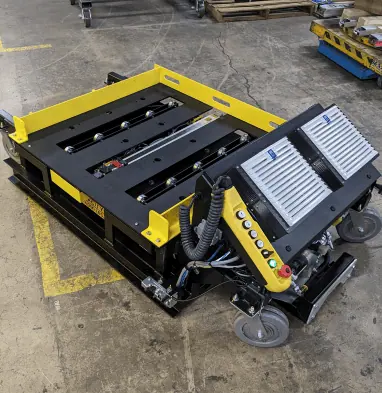
8:01 pm | Comments Off on Equipment Loading and Transport Machine (Rotating Lift Cart)